





menu

Emergency Tarping Service in New Orleans – 24/7 Response to Stop Water Damage Within Hours

When your roof is compromised, every minute counts. Heritage Roofing New Orleans deploys emergency tarping service across the metro within hours, protecting your property from additional water intrusion while you arrange permanent repairs.

Slider Image 1
Slider Image 2
Slider Image 3
Slider Image 4
Slider Image 5
Slider Image 7
Slider Image 8
Slider Image 9
Slider Image 10
Slider Image 11

Why New Orleans Roofs Need Immediate Tarping After Storm Damage

A damaged roof in New Orleans is not just an inconvenience. It is a countdown to structural disaster. Our subtropical climate delivers an average of 64 inches of rain annually, making exposed roof decking vulnerable to rapid water infiltration. When a tree limb punctures your roof or hurricane-force winds tear off shingles, you have a narrow window before rain turns a manageable repair into a full attic replacement.

The city's high water table and historic drainage challenges mean moisture does not evaporate. It sits. It soaks into plywood sheathing, saturates insulation, and breeds mold within 48 hours. Many homes in Lakeview, Gentilly, and the Garden District feature century-old framing that absorbs water like a sponge. Once that happens, structural rot accelerates faster than in drier climates.

Emergency roof tarp installation is not about buying time. It is about stopping the bleed. A properly secured tarp prevents additional rainfall from reaching your attic, walls, and ceilings while your insurance adjuster completes their assessment. 24 hour roof tarping means we respond when you call, day or night, because Gulf storms do not wait for business hours.

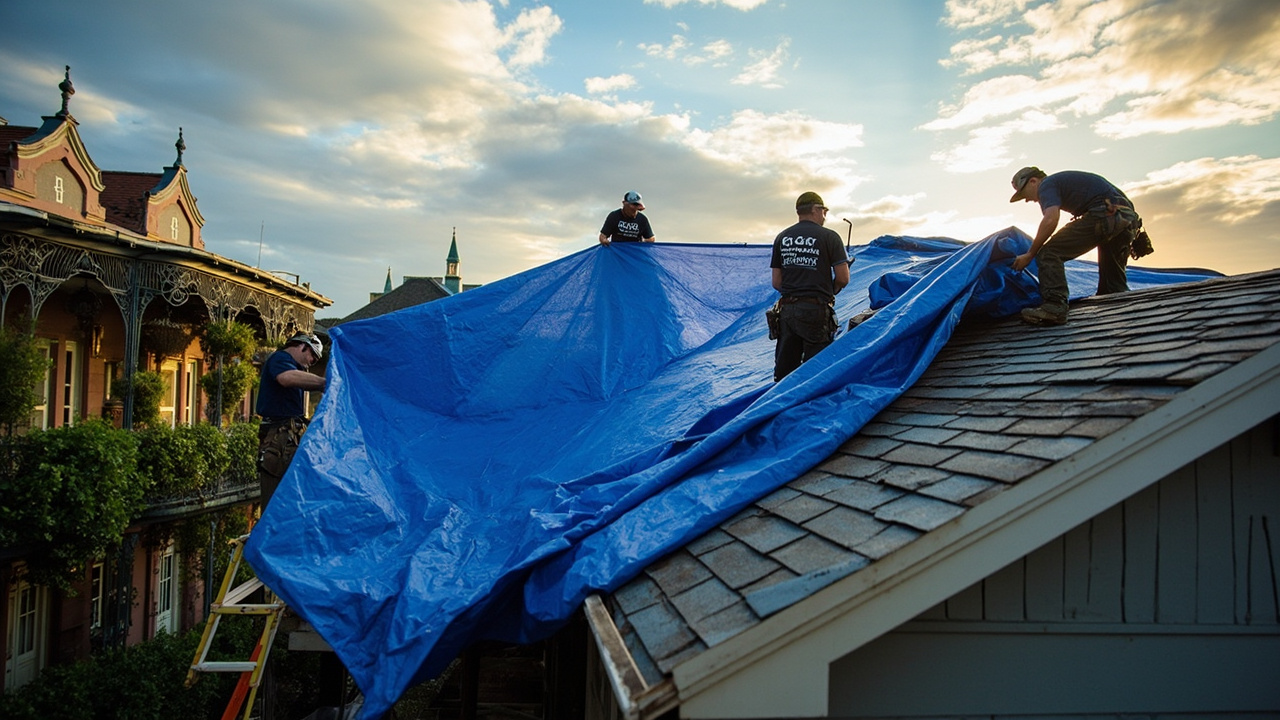
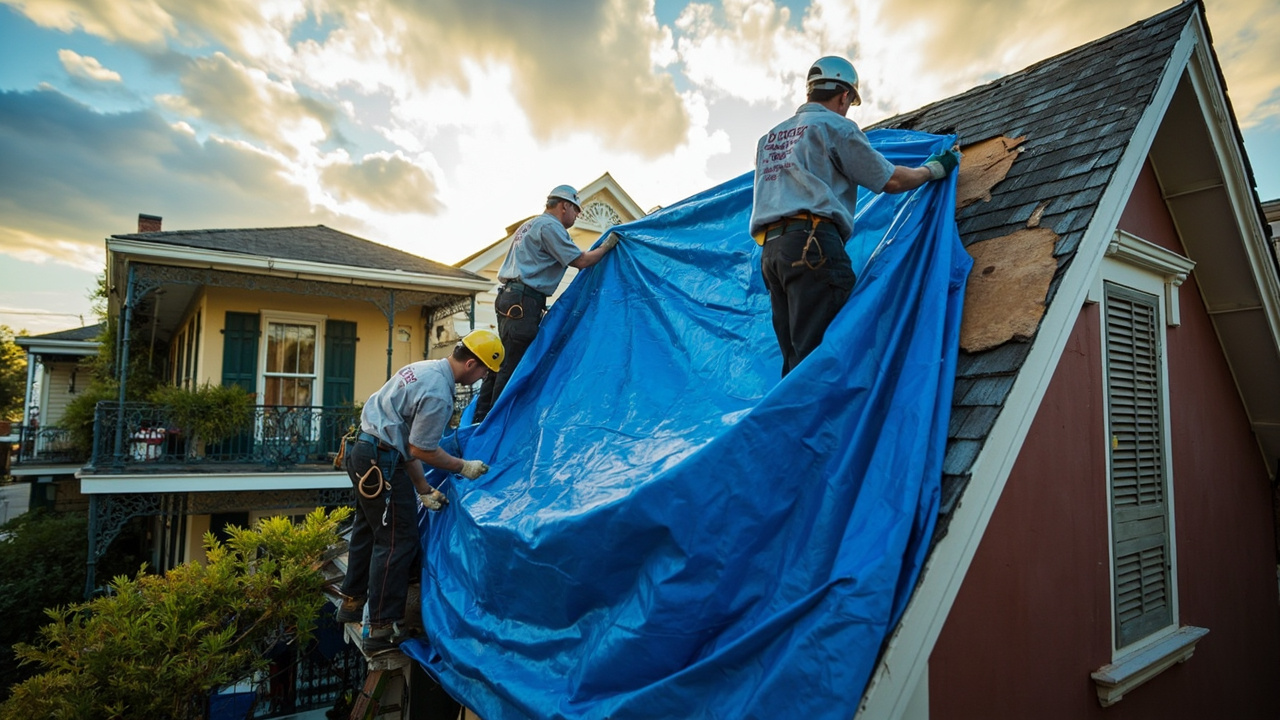
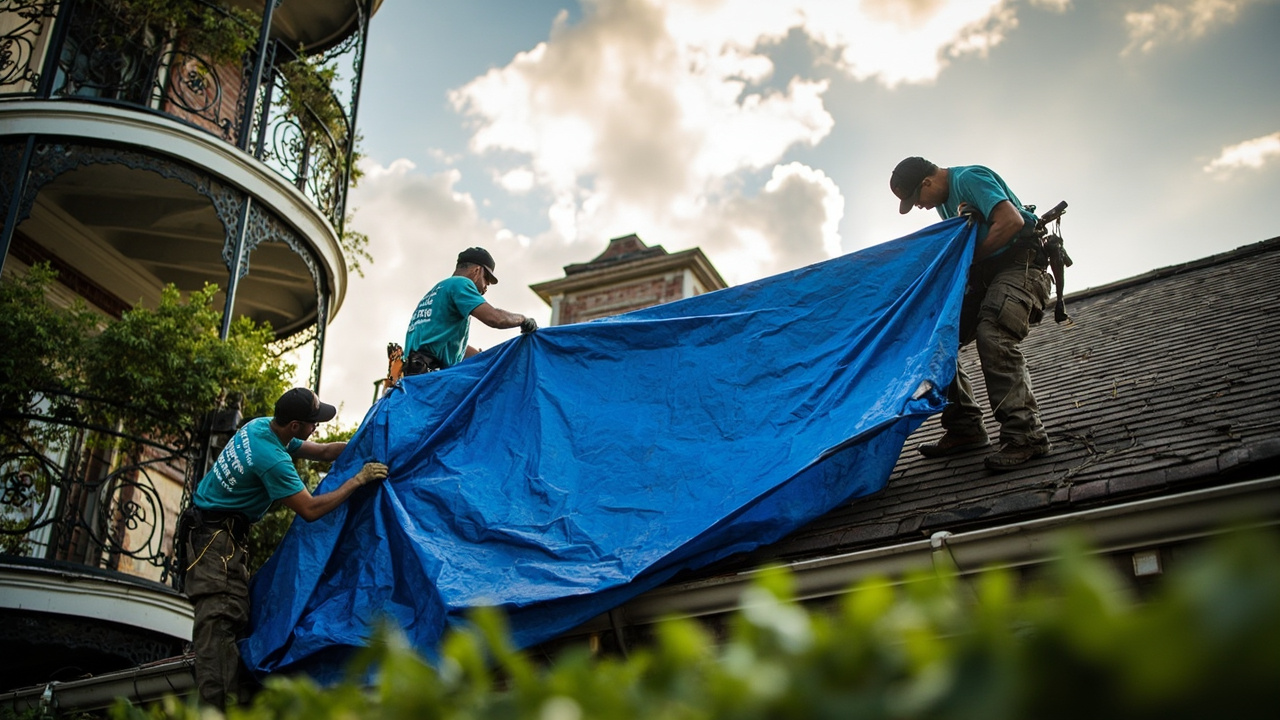
Temporary roof covering services must account for New Orleans wind loads. We do not use hardware store tarps that flap loose in the first thunderstorm. Our urgent roof tarping process uses heavy-duty polyethylene secured with counter-battening and anchored to structural members, not just nailed to compromised decking. Storm damage roof tarping requires understanding how wind uplift works on hip roofs versus gable roofs, and how to tension the material so it sheds water instead of pooling it.

Why New Orleans Roofs Need Immediate Tarping After Storm Damage
How We Secure Emergency Tarps to Withstand Tropical Weather

How We Secure Emergency Tarps to Withstand Tropical Weather

Most tarping failures happen because contractors treat it like a temporary patch job. They stretch blue poly over a hole, nail down the edges, and call it done. That approach fails within days when afternoon thunderstorms hit 40 mph gusts. We approach storm damage roof tarping as engineered temporary roofing, not a Band-Aid.

First, we assess the extent of the compromised area. If wind tore off shingles but left underlayment intact, we determine whether the felt paper can hold or if it needs reinforcement. If the decking is exposed or punctured, we measure the opening and size the tarp to extend at least four feet beyond the damaged zone in all directions. This overlap is critical for preventing wind-driven rain from migrating under the edges.

Next, we install counter-battening. This means securing dimensional lumber over the tarp edges, not just along the perimeter but also across the field of the tarp in a grid pattern. The battens are screwed into rafters or trusses, not just sheathing. This creates a mechanical attachment that resists uplift. We space fasteners every 12 inches and use corrosion-resistant screws rated for coastal exposure, because New Orleans salt air corrodes standard hardware within weeks.

We tension the tarp so water sheds toward the eaves, not toward the ridge. Pooling water adds weight and creates stress points where the material can tear. For large damaged areas, we overlap multiple tarps with a minimum six-inch lap, sealed with mastic tape to prevent capillary action from drawing water through the seam.

This is not a one-hour job. Proper emergency roof tarp installation on a steep pitch roof with multiple penetrations can take a crew three to four hours. But it holds through tropical storms while you arrange permanent repairs.

What Happens When You Call for Emergency Roof Tarping

Emergency Tarping Service in New Orleans – 24/7 Response to Stop Water Damage Within Hours
01

Immediate Dispatch and Assessment

When you call our emergency line, we do not schedule an appointment. We dispatch a crew immediately. Our team arrives with tarping materials, safety equipment, and ladders sized for two and three-story structures. We conduct a rapid roof assessment to identify all compromised areas, not just the obvious hole. Wind damage often creates secondary failures that are not visible from the ground. We document the damage with photos for your insurance claim before we cover anything.
02

Structural Tarp Installation

Our crew secures heavy-duty polyethylene using counter-battening anchored to structural framing members. We do not nail into compromised decking. Each attachment point is spaced to meet wind load requirements for our coastal zone. For punctures through the roof deck, we reinforce the opening from the interior with plywood bracing before applying the exterior tarp. This prevents the tarp from sagging into the attic space and creating a water collection point.
03

Temporary Weatherproofing Verification

Before we leave, we verify the tarp is properly tensioned and all edges are sealed against wind-driven rain. We inspect the attic interior to confirm no additional water intrusion points exist. You receive documentation of the temporary repairs, including photos of the installation method, for your insurance adjuster. We provide a timeline for permanent repair estimates and remain on call if the tarp requires adjustment after subsequent weather events. This is urgent roof tarping that holds until your roof is permanently restored.

Why New Orleans Property Owners Trust Heritage Roofing for Emergency Response

Emergency tarping service in New Orleans requires more than a truck full of blue tarps. It requires understanding how our building stock behaves under stress. Many homes in Mid-City and Uptown feature hip roofs with complex valley configurations. A poorly installed tarp over a valley will funnel water directly into the attic at the convergence point. We know where to anchor battens to avoid crushing clay tiles on historic structures and how to work around century-old slate roofing without causing additional damage.

Our crews are familiar with the Orleans Parish building department's requirements for temporary weatherproofing. After a named storm, the city expects property owners to mitigate further damage within a reasonable timeframe. Insurance adjusters note whether emergency measures were taken promptly. We document our work with timestamped photos and detailed installation notes that satisfy adjuster requirements and protect you from claim disputes.

We also understand the urgency of 24 hour roof tarping in a city where afternoon thunderstorms deliver an inch of rain in 20 minutes. If your roof is compromised at 11 PM, you cannot wait until morning. Water does not wait. Mold spores begin colonizing damp surfaces within 24 to 48 hours, and New Orleans humidity accelerates that timeline. Our emergency response team is on call around the clock, not just during business hours.

Heritage Roofing New Orleans has secured emergency tarps on everything from shotgun doubles in the Bywater to commercial flat roofs in the Central Business District. We carry commercial-grade materials rated for sustained winds up to 70 mph, because we know what temporary roof covering services must withstand during hurricane season. When we install an emergency tarp, it stays in place until permanent repairs are completed, not just until the next rain band passes through.

What to Expect When You Need Emergency Roof Tarping

Response Time and Availability

We dispatch emergency tarping crews 24 hours a day, seven days a week. When you call, you reach a live person who coordinates immediate deployment. Our goal is to have a crew on-site within two to four hours, depending on your location within the metro area and current weather conditions. We do not wait until morning or until the storm passes completely. As soon as wind speeds drop below unsafe working thresholds, our teams are on roofs. After major weather events, we prioritize calls based on severity of exposure and risk of additional structural damage, but we respond to every request the same day.

Damage Assessment and Documentation

Before we cover anything, we document the full extent of visible damage. This includes photographs from multiple angles, measurements of the compromised area, and notes on the condition of surrounding roofing materials. We inspect the attic interior to assess water intrusion and structural integrity of the roof deck. This documentation becomes part of your insurance claim file. We provide you with copies of all photos and a written summary of the damage observed. If your adjuster requests additional information about the pre-repair condition, we have it on record. This protects you from disputes about the scope of damage.

Tarp Installation Quality Standards

Our emergency tarps are not temporary fixes that fail in the next storm. We use commercial-grade polyethylene with UV inhibitors, because tarps in New Orleans often remain in place for weeks while insurance claims are processed and materials are sourced. Counter-battening is secured with corrosion-resistant fasteners anchored into structural framing, not just surface nails. The tarp extends beyond the damaged area with proper overlap and is tensioned to shed water toward the eaves. We install with the same attention to detail we apply to permanent roofing, because your property protection depends on it holding until repairs are completed.

Follow-Up and Permanent Repair Coordination

After the emergency tarp is installed, we do not disappear. We provide a detailed estimate for permanent repairs and work with your insurance adjuster to document the scope of work required. If weather conditions change or the tarp requires adjustment, we return to reinforce or re-secure as needed at no additional charge for the duration of the temporary coverage period. Once your claim is approved and materials arrive, we schedule the permanent repair and remove the tarp as part of the restoration process. You have one point of contact from emergency response through final repair, eliminating coordination headaches during an already stressful situation.

Frequently Asked Questions

You Have Questions,
We Have Answers

How much does emergency roof tarping cost? +

Emergency roof tarping in New Orleans costs between $200 and $1,500, depending on roof size, damage extent, and accessibility. A single-story home with minor storm damage costs less than a two-story property with extensive wind uplift. After a hurricane, prices may increase due to high demand. Most homeowners insurance policies cover emergency tarping as part of loss mitigation. Get multiple quotes and confirm your contractor can bill your insurance directly. Speed matters after a storm. Water intrusion causes mold growth fast in our humid climate, so tarp immediately to prevent secondary damage.

How much does insurance pay for tarping? +

Insurance covers emergency tarping as a temporary protective measure under most standard homeowners policies. Tarping falls under your dwelling coverage and is considered damage mitigation. Your insurer wants you to prevent further loss, so they typically reimburse the full cost without applying your deductible. Save all receipts and take photos before and after tarping. Contact your insurance company within 24 hours of the damage. In New Orleans, post-hurricane claims can take weeks to process, but emergency tarping expenses are usually approved quickly since they protect the insurer from larger interior damage claims.

Will Fema put a tarp on my roof? +

FEMA provides free blue roof tarping through the Blue Roof Program after presidentially declared disasters. The program targets homeowners who cannot afford temporary repairs and lack insurance coverage. FEMA contracts with the Army Corps of Engineers to install tarps at no cost. You must register with FEMA first, then wait for scheduling. After hurricanes in New Orleans, wait times can stretch to weeks due to high demand. If you have insurance or can afford private tarping, use a local contractor instead. FEMA tarps are meant for uninsured, low-income residents facing genuine financial hardship.

How do I get a new roof if I can't afford it? +

If you cannot afford a new roof, explore these options. File an insurance claim if you have coverage. Apply for a home equity loan or personal loan with manageable payments. Check for FEMA assistance if a federal disaster was declared in New Orleans. Louisiana Housing Corporation offers repair grants for low-income homeowners. Some roofers provide financing plans. Look into nonprofit programs like Rebuilding Together New Orleans. Document all damage with photos. Get multiple estimates. Emergency tarping buys you time to arrange financing while preventing water damage. Do not delay protection because water intrusion worsens daily in our humid climate.

How much to put a roof on a 2000 sq ft house? +

Roofing a 2,000 square foot house in New Orleans costs $8,000 to $20,000, depending on material choice and roof complexity. Asphalt shingles are the budget option. Metal roofing costs more upfront but withstands hurricanes better. Prices fluctuate after major storms due to demand. Steep pitches, multiple valleys, and historic home requirements increase labor costs. This estimate excludes decking replacement if water damage compromised the substrate. Insurance typically covers replacement if storm damage totaled your roof. Get three written estimates. Verify contractors are licensed and insured. Avoid lowball quotes that signal corner-cutting or unlicensed labor.

How long do Fema tarps last? +

FEMA blue tarps last three to six months under normal conditions. In New Orleans, high heat, UV exposure, and afternoon thunderstorms degrade tarps faster. Wind uplift loosens attachments. Expect tears and sagging after 90 days. FEMA tarps are temporary emergency protection, not long-term solutions. Schedule permanent roof repairs immediately after installation. If you wait too long, the tarp will fail and water will penetrate your home. Monitor the tarp weekly for loose edges or pooling water. Re-secure or replace sections as needed. Do not treat a FEMA tarp as a permanent fix.

What not to say to a roof insurance adjuster? +

Never tell your roof insurance adjuster you are unsure when damage occurred or that pre-existing issues existed. Do not guess about cause. Do not say the roof was old and needed replacement anyway. Avoid admitting you delayed repairs or missed maintenance. Never sign anything without reading it fully. Do not accept the first settlement offer without getting independent estimates. Stick to facts. Show documentation and photos. Let the adjuster inspect without leading their conclusions. In New Orleans, adjusters see hurricane claims constantly. They know the difference between wind damage and wear. Be honest but cautious with your words.

How long will a tarped roof last? +

A properly installed tarp lasts 90 days in New Orleans weather conditions. High-quality tarps with reinforced grommets and proper fastening can extend to four months. Afternoon storms, intense sun, and high humidity accelerate deterioration. Tarps are temporary emergency protection only. Water can pool in low spots, creating leaks. Wind will eventually loosen attachments. Inspect your tarp weekly and tighten or patch as needed. Schedule permanent repairs immediately. The longer you wait, the higher your risk of interior water damage, mold growth, and insulation saturation. Tarps buy you time but are not roofing solutions.

What is the 80% rule in homeowners insurance? +

The 80% rule requires you to insure your home for at least 80% of its replacement cost to receive full claim payouts. If you underinsure, the insurance company applies a penalty and pays only a proportional amount. For example, if your home needs $200,000 to rebuild but you only carry $120,000 in coverage, you are underinsured. The insurer will reduce your claim payment accordingly. In New Orleans, reconstruction costs fluctuate after hurricanes due to labor shortages and material price spikes. Review your dwelling coverage annually and adjust for inflation and rising construction costs.

What is FEMA's $700 assistance program? +

FEMA offers Serious Needs Assistance, a one-time $750 payment for immediate emergency expenses after a federally declared disaster. You must apply through DisasterAssistance.gov or call FEMA directly. The funds help cover food, water, medication, and temporary shelter costs. This is not specifically for roof tarping. FEMA distributes this assistance quickly to address life-safety needs. In New Orleans, apply immediately after a hurricane declaration. The payment does not require repayment. Additional FEMA programs may cover temporary housing or home repairs if you qualify. Register within 60 days of the disaster declaration to remain eligible for assistance.

How Hurricane Season and Afternoon Storms Make Emergency Tarping Critical in New Orleans

New Orleans sits in the crosshairs of Gulf storm systems from June through November, but roof damage happens year-round. Summer afternoon thunderstorms routinely produce 50 mph straight-line winds that tear off aging shingles and lift metal flashing. The subtropical climate means rain follows within hours, not days. A roof compromised on Monday afternoon will be leaking into your attic by Tuesday morning if not secured. The city's position below sea level and high water table mean moisture does not evaporate quickly. It saturates materials and creates ideal conditions for mold colonization. Emergency roof tarp installation in New Orleans is not about convenience. It is about preventing a minor roof failure from escalating into a five-figure remediation project involving structural drying, mold abatement, and interior reconstruction.

New Orleans building codes and insurance requirements expect property owners to mitigate damage promptly after a weather event. Failure to secure a damaged roof can result in claim denials for subsequent water damage deemed preventable. Local roofers familiar with Orleans Parish permitting and inspection requirements understand how to document temporary repairs in a manner that satisfies both insurance adjusters and code enforcement. Heritage Roofing New Orleans has worked with every major insurance carrier active in the metro area and knows exactly what documentation they require. When you call us for storm damage roof tarping, you are not just getting a tarp. You are getting a local team that understands how to protect your claim and your property simultaneously.

Roofing Services in The New Orleans Area

Our dedicated team is proud to serve the entire area, bringing our legacy of quality roofing services directly to your neighborhood. Whether you need a simple repair, a full-scale replacement, or an urgent inspection, you can find us easily on the map below. We are committed to being your local roofing partner, delivering expert solutions right where you are. We look forward to working with you to protect your most valuable asset—your home.Our dedicated team is proud to serve the entire area, bringing our legacy of quality roofing services directly to your neighborhood. Whether you need a simple repair, a full-scale replacement, or an urgent inspection, you can find us easily on the map below. We are committed to being your local roofing partner, delivering expert solutions right where you are. We look forward to working with you to protect your most valuable asset—your home.

Address:
Heritage Roofing New Orleans, 3308 Tulane Ave, New Orleans, LA, 70119

Additional Services We Offer

Our news updates

Latest Articles & News from The Blogs

The 10 Critical Questions That Could Save Your New Orleans Home Roofing in New Orleans isn't just about shingles and…

Questions You Must Ask a New Orleans Roofer Before Signing a Contract

The 10 Critical Questions That Could Save Your New Orleans Home Roofing in New Orleans isn't just about shingles and…

Restoring the Intricate Turrets and Gables on Victorian Homes in the Holy Cross District

Restoring the Intricate Turrets and Gables on Victorian Homes in the Holy Cross District The Holy Cross District in New…

Is Stone Coated Steel the Right Choice for Your Slidell Waterfront Property?

Is Stone Coated Steel the Right Choice for Your Slidell Waterfront Property? Living along the water in Slidell comes with…

Contact Us

Your roof is compromised. Every hour you wait, water moves deeper into your structure. Call Heritage Roofing New Orleans now at (504) 355-3444. Our emergency crews are standing by 24/7 to secure your property and stop the damage before it spreads.